What Leo saw in Enron's mail, 1. Where is the signed contract?
We gave Leo the email eleven people at Enron sent in early 2001, and nothing else. Seven lawyers each wrote about the deal in front of them. Leo joined them into one problem none of them could see alone: nobody was sure where the signed contracts were.
Most of what a company knows lives in its email. Nobody writes the handbook; people just send messages. So we tried something harder than a handbook. We gave Leo the email eleven people at Enron sent in the first three months of 2001, from the public record of the company's mail, and nothing else. No handbook, no org chart, no names: each person was taught to Leo by team and number. Could Leo work out how the work moved, from the mail alone?
The company collapsed later that year. That is not this story. This is about ordinary work: the contracts, confirmations and gas deals of an ordinary quarter.
Where this mail comes from
The Enron email corpus was made public during the federal investigation of the company and is published by Carnegie Mellon University for research. Nobody at Enron took part in this. We used only what each person wrote themselves, taught them to Leo by team and number, and name nobody here.
The claims, and where to check them
| Claim | Where to check it |
|---|---|
| We gave Leo the mail eleven people sent in the first quarter of 2001: eight lawyers, one trading operations specialist and two gas logistics staff, each as their own person, and nothing else | The public Enron email corpus, CMU copy of May 2015 (cs.cmu.edu/~enron) |
| Seven of the eight lawyers described the same problem: nobody could be sure which agreements had been signed, or where the signed copy was | Their sent mail, January to March 2001 |
| Signed agreements lived as paper files in a cabinet, with their status meant to be kept in a database that was often out of date | The same mail |
| In January 2001 the group trialled a "library approach": a signed card left in the cabinet in place of any file taken out | One lawyer's mail, 24 and 25 January 2001 |
| Leo read the eleven mailboxes, 3 million characters, in about an hour, for US$22 | Leo's own run log |
The work as it was
Enron's lawyers negotiated the master agreements that every trade sat on: the contracts that set the terms for each counterparty, before a single deal was done. Once signed, an agreement went into a paper file, a "blue file", in a shared cabinet. Its status was meant to be recorded in a database, so traders could check before they traded.
In practice, the mail tells a different story. Files went missing. One lawyer asked the group: "Does anyone have the blue file for [a counterparty]? We need to amend the Master and the blue file is not in the file cabinet." An executed agreement could not be found, so the counterparty was asked to send its copy. Agreements signed in another office were never logged. Status updates went by email instead of into the database. And sometimes nobody could tell whether an agreement existed at all.
In late January the group tried a fix of its own: "we are testing out the 'library approach' and instituting a checkout procedure. Whenever you remove one of these files from the file cabinet, please 'hold the file location' with a signed" card.
What Leo saw
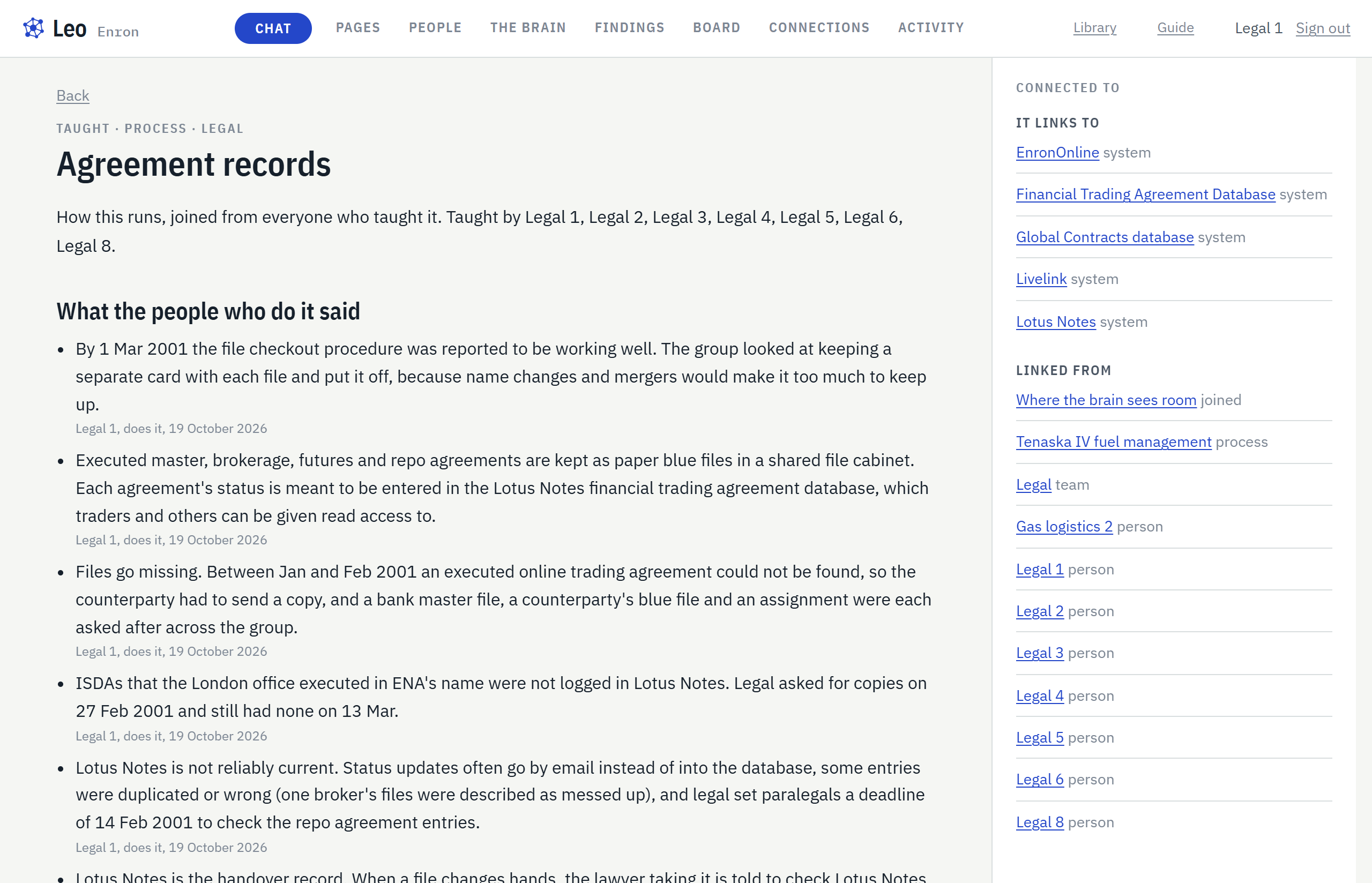
No single lawyer described the whole problem. Each wrote about the agreement in front of them. Leo heard seven of them separately and joined the pieces into one account: paper files, a database not reliably current, agreements signed elsewhere and never logged, and the same question asked again and again, does this agreement exist?
The ways forward
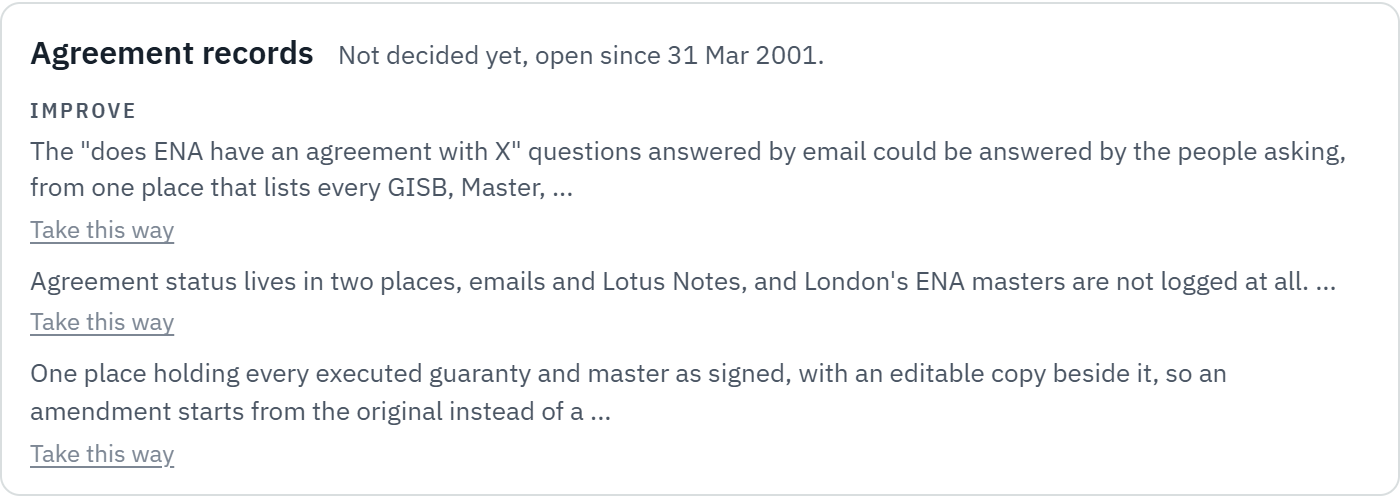
- Improve: one place that answers "do we have an agreement with them?" Every agreement in force, listed where the person asking can look it up, instead of emailing a lawyer.
- Improve: one record of status. The database is the only place status is written, with nothing kept in email, and agreements signed in other offices logged there too.
- Improve: the signed copy beside the record. Every executed agreement held as signed, with an editable copy, so an amendment starts from the original, not a request for a paper copy.
A quarter later
We gave the same Leo the same people's mail for April to June 2001. The problem was still there: in April the group was still being asked "Does anyone have this file?". But by May one lawyer was sending colleagues links to executed agreements in the document system instead of looking for the paper. Leo added 35 lines to this page from the new mail, and a new way on the card: every executed agreement imaged into that system when it is signed. post 4 has the whole quarter.
What this does not show
The mail shows what people wrote, not everything they did. The checkout card was a sensible fix, and the group said by March it was working. What the mail shows, and what no single person in it could see, is that seven lawyers were each solving the same problem on their own: where is the signed contract?
Leo learns how a business really runs from what its people write and say, lays out the ways the work could go, side by side, and keeps the choice with the people who make it.