What Leo saw in Enron's mail, 4. The playbook nobody wrote, kept up by the next quarter's mail
Leo drew 63 processes from three months of eleven people's email in 47 minutes, for US$22. Given the next three months, it did not start again: it updated 47 pages, added 26, and caught the lawyers deciding to drop confirmations, a change it had not suggested.
The worry we hear most from firms that look at Leo is the setting up. A playbook, a handbook, a map of how the work runs: somebody has to write it, and that takes hundreds of hours nobody has. Then it goes out of date.
So we tried it the other way round. Nobody at Enron wrote a playbook for us. We gave Leo the mail eleven people sent in the first three months of 2001, eight lawyers, one trading operations specialist and two gas logistics staff, each taught as their own person by team and number. Then we gave it the next three months, the same eleven people, and watched what happened to the playbook it had drawn.
Where this mail comes from
The Enron email corpus was made public during the federal investigation of the company and is published by Carnegie Mellon University for research. Nobody at Enron took part in this. We used only what each person wrote themselves, taught them to Leo by team and number, and name nobody here.
The claims, and where to check them
| Claim | Where to check it |
|---|---|
| Leo was given eleven people's sent mail, January to March 2001, and nothing else: no handbook, no org chart, no names. It drew 63 processes from it in 47 minutes of reading, for US$21.85 | The public Enron email corpus, CMU copy of May 2015 (cs.cmu.edu/~enron); Leo's own run log for this test |
| The same eleven people's mail for April to June 2001 was then given to the same Leo. In 51 minutes, for US$19.71, it added 26 processes and updated 47 of the pages it already had | the brain's own history, page by page; Leo's own run log for this test |
| One gas logistics specialist began covering steady meters for a year at a time in the first quarter ("I have created deal [number] to cover this meter for the next year", 6 Feb 2001; "I extended deal [number] through Dec 01", 7 Mar). Requests about gas flowing with no deal behind it fell from 29 in 13 weeks of that person's sent mail to 6 in 10 weeks | That specialist's sent mail, both quarters: subject lines naming a meter, counted by hand |
| Legal asked on 25 April 2001 whether online trades could go without confirmations, sent a first draft of a "No More Confirms Agreement" on 9 May, and on 26 June wrote: "We have approved doing away with confirms for EOL trades on a counterparty by counterparty basis." | One lawyer's sent mail, 25 Apr, 9 May and 26 Jun 2001 |
| In April the lawyers were still asking the whole group "Does anyone have this file?"; by May one was sending colleagues links to executed agreements in the document system, Livelink | Two lawyers' sent mail, April and May 2001 |
The first quarter: a playbook from nothing
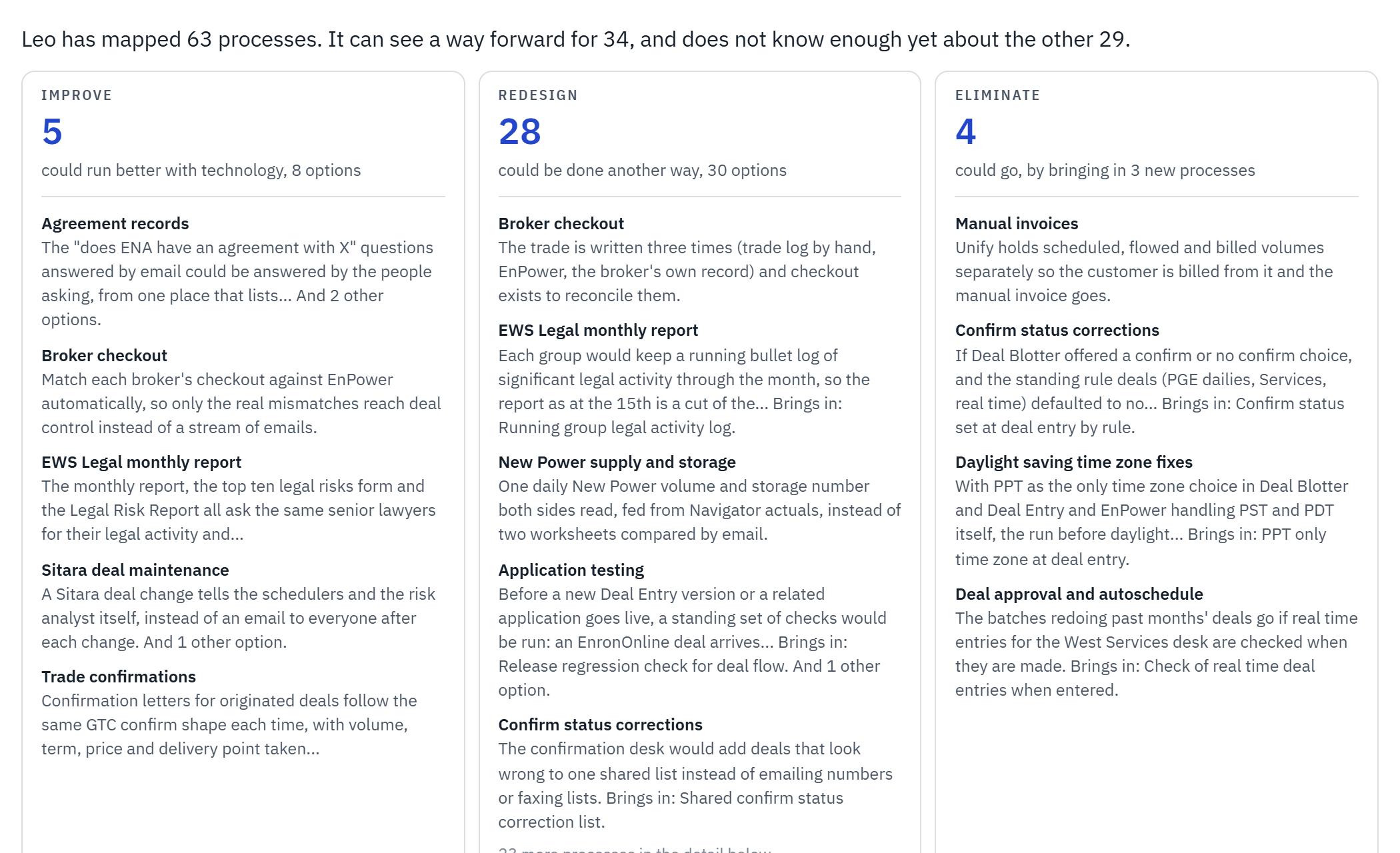
In 47 minutes of reading, Leo drew 63 processes from the mail: how master agreements were negotiated and filed, how a trade confirmation moved from desk to lawyer to counterparty, what happened when gas flowed with no deal behind it, and 60 more. Each one is a page with who does it, the systems it runs through, the steps where it hurts, and the ways it could run better. Nobody at Enron spent an hour on it. The first three posts in this series came out of that one pass.
The second quarter: the playbook kept itself up
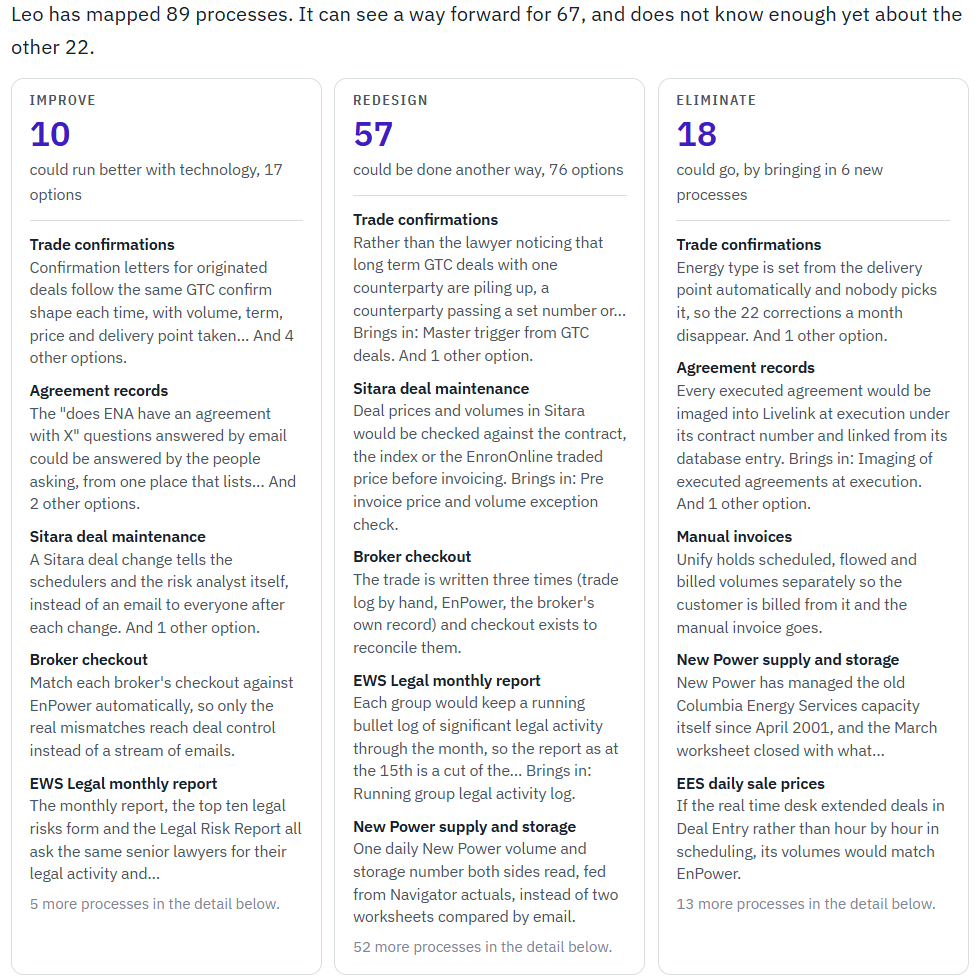
We gave the same Leo the same eleven people's mail for April to June. It read it in 51 minutes for US$19.71. It did not start again. It added what was new, 26 processes it had not seen, and updated 47 of the pages it already had, with the date and the person each new line came from. After a second look at every process, it could see a way forward for 67 of 89, up from 34 of 63.
Three of the updates are the kind a written playbook would need someone to notice and write down.
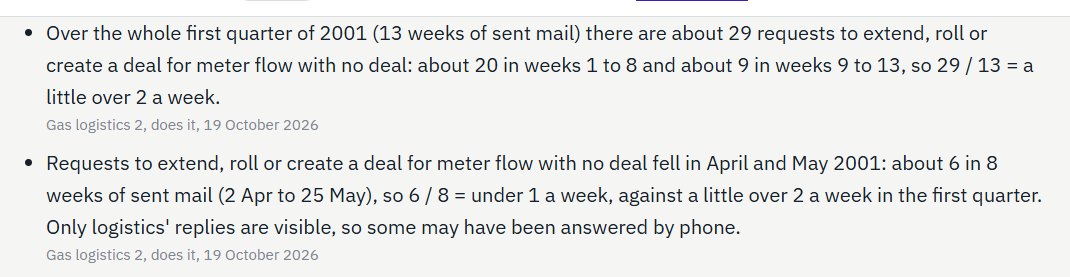
1. A change that worked. In the first quarter Leo found that gas kept flowing at meters after the deals behind them had ended, about two requests a week to fix one, and suggested a check before the month starts so expiring deals are rolled ahead. The specialist doing the work had already started on the same idea: "I have created deal [number] to cover this meter for the next year." That way was marked on Leo's card as the one taken. The second quarter's mail shows what happened next: requests fell from 29 in 13 weeks to 6 in 10, from about a fifth of that person's sent mail to about a twentieth. Leo put the two counts side by side on the page, without being asked.
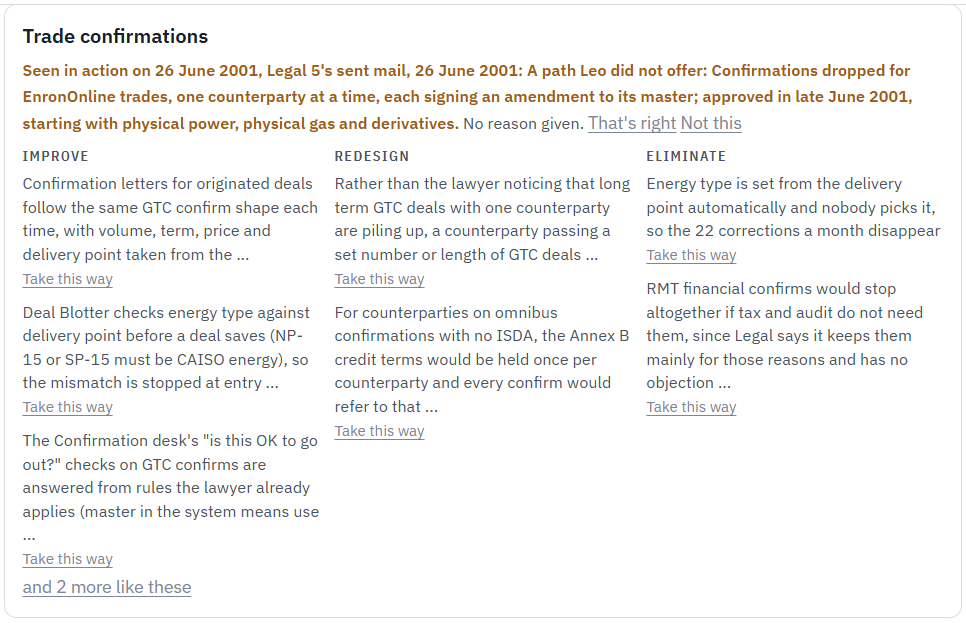
2. A change Leo did not suggest. For trade confirmations, Leo's first quarter card offered ways to produce the documents faster. The lawyers went further. On 25 April one asked whether online trades needed confirmations at all; on 9 May the same lawyer sent round a first draft of a "No More Confirms Agreement", with "Please feel free to rip it to shreds"; on 26 June: "We have approved doing away with confirms for EOL trades on a counterparty by counterparty basis." Leo wrote the decision onto the page and closed its own open question about it. The card now shows it as a path taken that Leo did not offer, and keeps the options that were not taken beside it.
3. A problem that had not gone away. In January the lawyers tried a checkout card for the paper files of signed agreements. In April the group was still being asked "Does anyone have this file?". By May one lawyer was sending colleagues links to executed agreements in the document system instead of looking for the paper. After the second quarter Leo's card for agreement records carries a new way: every executed agreement imaged into that system when it is signed, under its contract number. That option came from the second quarter's mail, not before it, so it is not a forecast. It is the playbook keeping up with what the people were already starting to do.
What it cost
| Leo's reading | Cost | Staff hours | ||
|---|---|---|---|---|
| First quarter | 3.0 million characters, 11 people | 47 minutes | US$21.85 | none |
| Second quarter | 2.2 million characters, the same 11 | 51 minutes | US$19.71 | none |
Six months of eleven people's work, drawn and kept current, for about US$42 and under two hours of Leo's time.
What this does not show
- The mail shows what people wrote, not everything they did. Calls, meetings and paper never reached Leo. A request answered by phone is not in the counts.
- Fewer requests about gas with no deal fits the year long deals, but the mail cannot prove the cause. Fewer meters, or a quieter season, could explain part of it.
- Leo recorded the June decision on confirmations on its page and closed its own question, but did not move the card by itself. We posted that path to the card from the dated mail, the way a routine would. In the same quarter Leo did post four other paths to their cards by itself.
- The people in it could not answer Leo's questions. In a live firm the person who did the work confirms or corrects each path in a sentence; here those wait, unanswered.
- The people in the mail never saw any of this, and the company's collapse later that year is not the subject.
Leo learns how a business really runs by reading what its people write and talking with them, lays out the ways the work could go, side by side, and keeps the choice with the people who make it. When they take a path, its card records it, including one Leo did not offer.