What Leo saw in Enron's mail, 3. Gas still flowing on deals that had ended
In early 2001 gas kept flowing at Enron meters after the deals behind it had ended: about 29 catch-up requests in 13 weeks, each found after the fact. Leo counted them, showed its working, and suggested checking before the month instead.
We gave Leo the email eleven people at Enron sent in the first three months of 2001, and nothing else. This story comes from the two who kept the gas deals straight.
Where this mail comes from
The Enron email corpus was made public during the federal investigation of the company and is published by Carnegie Mellon University for research. Nobody at Enron took part in this. We used only what each person wrote themselves, taught them to Leo by team and number, and name nobody here.
The claims, and where to check them
| Claim | Where to check it |
|---|---|
| In the first quarter of 2001, gas kept flowing at meters after the deals behind it had expired, bringing about 29 requests to extend, roll or create a deal, a little over two a week | Two gas logistics staff's sent mail, January to March 2001, in the public Enron email corpus (cs.cmu.edu/~enron) |
| Gas with no deal behind it was booked to a holding contract until someone extended the old contract, made a new deal, or signed a printed form to write the volume off | The same mail, January 2001 |
| One correction to a transport cost on a single deal moved about $68,000 between two books | One gas logistics specialist's mail, March 2001 |
The work as it was
Gas flows through meters, and every flow needs a deal behind it: who sold it, at what price, under which contract. When a deal ended but the gas kept flowing, the volume had nowhere to go. It was booked to a holding contract, which the mail calls "the HPL Strangers Gas Contract", until someone fixed it.
The fix was always one of three, set out in a request like this one: "Logistics need either (1) Purchase Contract... extended, (2) new deal & contract, or (3) approval to write-off these volumes to Unaccounted for Gas. (Please print, sign, and return original...)"
Over the quarter, about 29 such requests went out, a little over two a week, each found after the gas had already flowed. And small changes carried real money: one correction to a transport cost on a single deal, a gas logistics specialist wrote, meant "We should see about $68,000.00 move" from one book to another.
What Leo saw
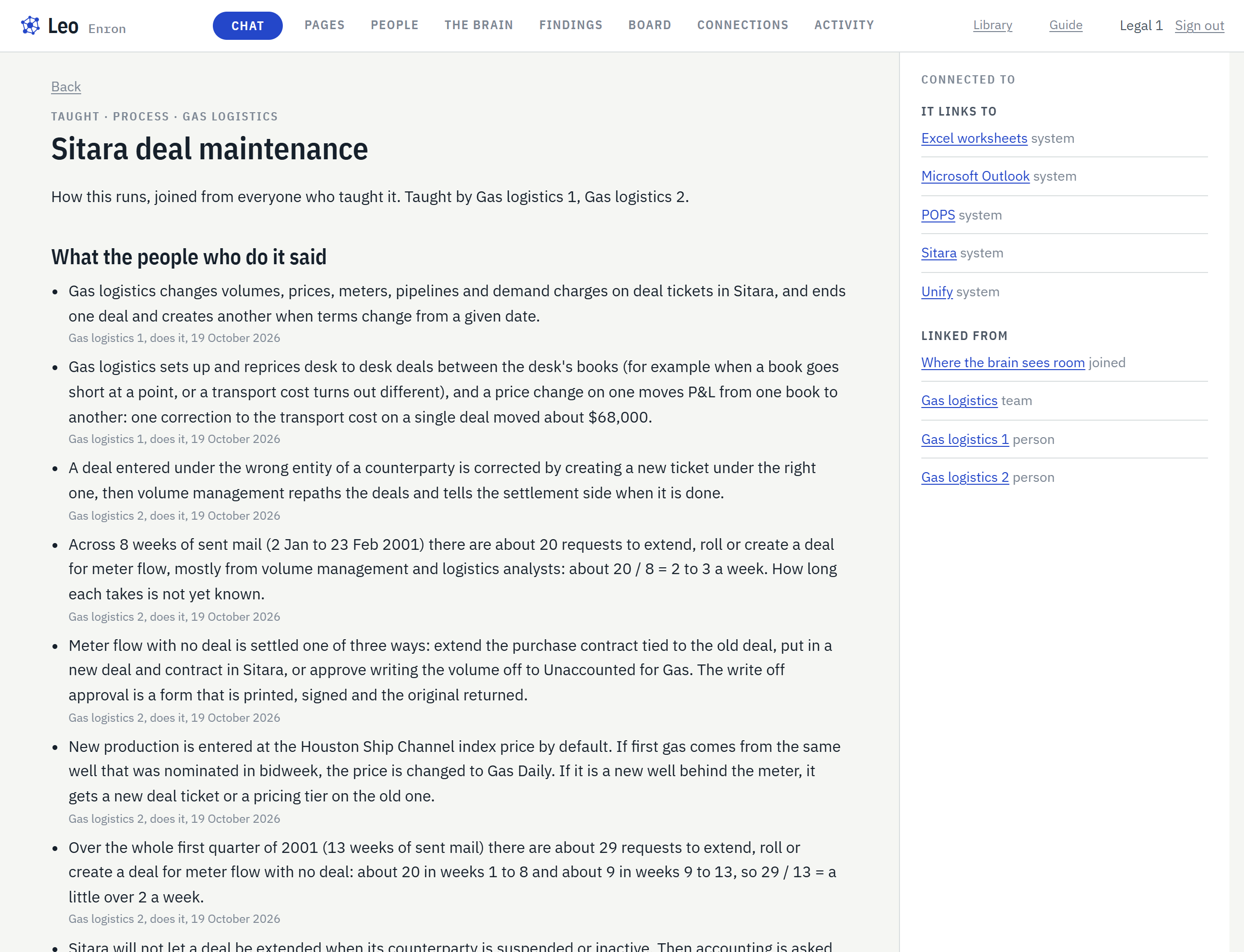
Leo joined the two logistics mailboxes and counted. It even did the arithmetic in the open: "about 20 in weeks 1 to 8 and about 9 in weeks 9 to 13, so 29 / 13 = a little over 2 a week." And it saw the pattern behind the requests: deals ending at meters that were still flowing, caught only afterwards.
The ways forward
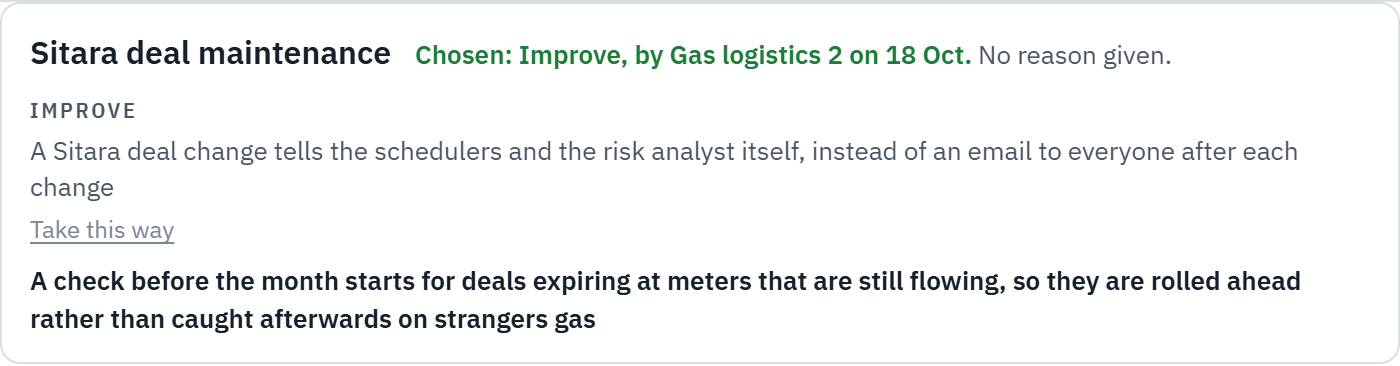
- Improve: check before the month starts. Look for deals expiring at meters that are still flowing, and roll them ahead, rather than catching them afterwards in the holding contract.
- Improve: let a deal change tell people itself. The schedulers and the risk analyst learn of a change from the system, not from an email to everyone after each one.
A quarter later
The specialist had already begun covering steady meters for a year at a time, the same idea as Leo's check before the month starts. Given the next quarter's mail, Leo counted again: 6 requests in 10 weeks of that person's sent mail, against 29 in the 13 weeks before, and put the two side by side on the page. post 4 has the whole quarter.
What this does not show
Leo counted the requests in the mail, not every request made, and the mail does not say how long each took. Some flow will always outrun the paperwork. What it shows is a steady weekly chase, after the fact, that a check before the month could have turned into a list.
Leo learns how a business really runs from what its people write and say, lays out the ways the work could go, side by side, and keeps the choice with the people who make it.