What Leo saw in Enron's mail, 2. The same terms, typed again on every trade
Nine trades with one customer carried three different credit thresholds, because each confirmation was typed fresh. A lawyer asked how to margin $1.3MM of exposure. Leo heard the same document from four sides, from the email alone.
We gave Leo the email eleven people at Enron sent in the first three months of 2001, and nothing else, each person by team and number. This is the second thing it saw that only reading several of them together would show.
Where this mail comes from
The Enron email corpus was made public during the federal investigation of the company and is published by Carnegie Mellon University for research. Nobody at Enron took part in this. We used only what each person wrote themselves, taught them to Leo by team and number, and name nobody here.
The claims, and where to check them
| Claim | Where to check it |
|---|---|
| Seven people across legal and trading operations described how a trade confirmation moved between them by hand | Their sent mail, January to March 2001, in the public Enron email corpus (cs.cmu.edu/~enron) |
| For one customer, nine trades carried three different exposure thresholds, $0 on seven, $500,000 and $25,000 on the others, against $1.3 million of exposure | One lawyer's mail, March 2001: "How do we margin this LC customer when the Exposure Thresholds are not consistant across each Annex B? Their financial mark to market exposure is currently $1.3MM." |
| The system that held confirmations stored each one apart from its credit annex, so seeing exactly what went out took a fax | The same lawyer's mail |
The work as it was
Every trade needs a confirmation: the document both sides sign to say what was agreed. At Enron in 2001 it passed through many hands. A trader or originator agreed the deal. A lawyer drafted or checked the confirmation, asking the trader for the volume, the delivery point and the price. The confirmation desk issued it. Credit added its own terms, in an annex, for each counterparty.
Where there was no master agreement, each confirmation carried its own credit terms, and each was typed fresh. So they drifted. One lawyer wrote in March: "How do we margin this LC customer when the Exposure Thresholds are not consistant across each Annex B? Their financial mark to market exposure is currently $1.3MM." Nine trades with one customer carried three different thresholds: $0 on seven of them, $500,000 on one and $25,000 on another.
What Leo saw
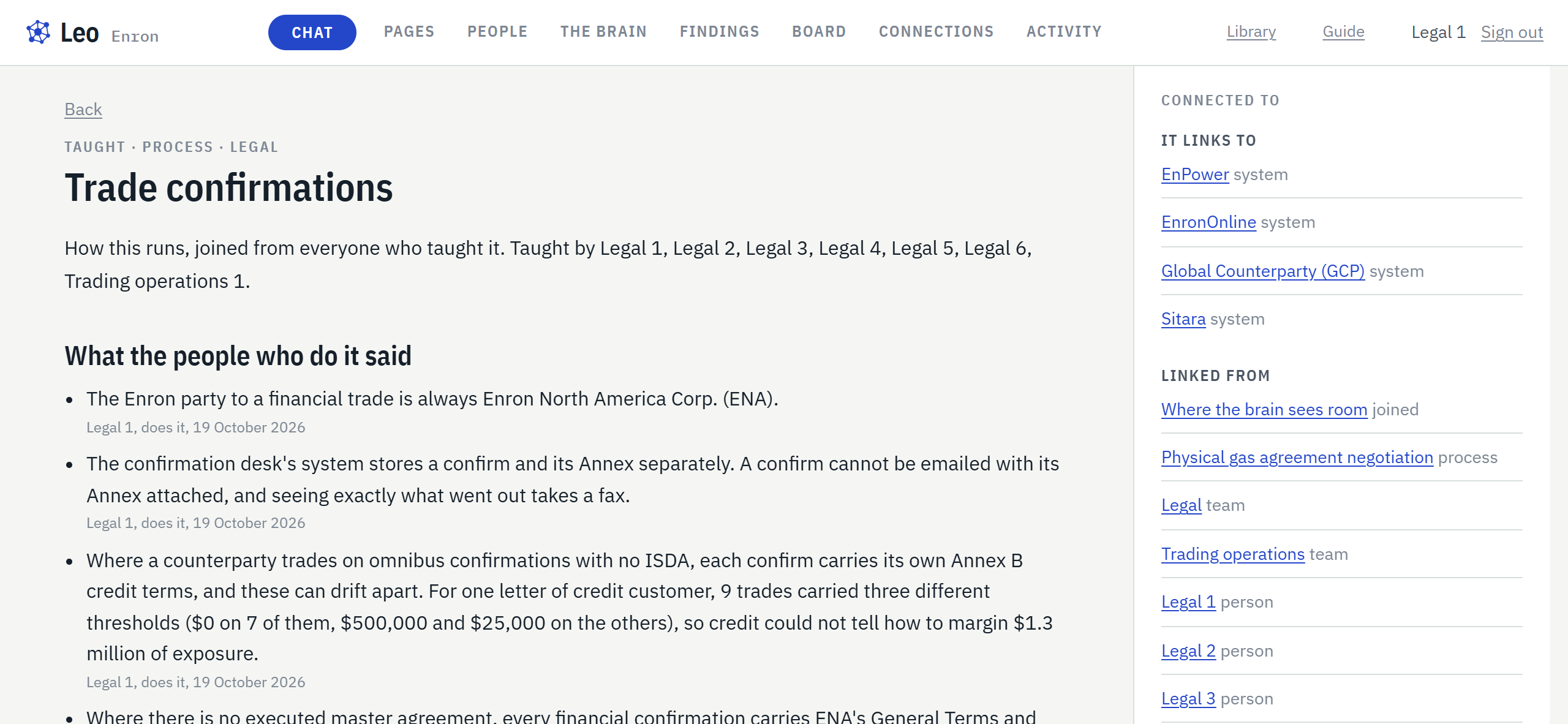
Leo heard the same document described from four sides: the lawyer drafting it, the lawyer fixing its credit terms, the trading operations specialist entering the deal, and the desk sending it. Each saw their own step. Leo saw the terms being retyped at every one of them.
The way forward

- Improve: draft the confirmation from the deal. The deal's volume, term, price and delivery point are already in the deal record and the originator's email. A first draft made from them leaves the lawyer to check, not to type, and the same credit terms go on every trade with the same customer.
A quarter later
The lawyers went further than any way on this card. On 25 April 2001 one asked whether online trades needed confirmations at all; on 26 June: "We have approved doing away with confirms for EOL trades on a counterparty by counterparty basis." Given the next quarter's mail, Leo wrote the decision onto the page, and the card now shows it as a path taken that Leo did not offer. post 4 has the whole quarter.
What this does not show
Mail shows the problems people wrote about, not the confirmations that went through cleanly, which were surely most of them. And credit terms are hard: some differences between trades may have been deliberate. What the mail shows is one customer's terms drifting across nine trades because each was typed fresh, and a lawyer who could not tell how to margin $1.3 million of exposure as a result.
Leo learns how a business really runs from what its people write and say, lays out the ways the work could go, side by side, and keeps the choice with the people who make it.