What Leo saw at GitLab, 4. Who owns which customer, kept in four places
At GitLab in 2019, who owns which customer was kept in four places that had to agree, and no single page said so. Leo joined the pages. Through 2021 the territory page was edited 86 times, one move at a time. Then the handbook copy went.
We gave Leo GitLab's public handbook exactly as it stood on 31 December 2019, and nothing later. This time it is a question every sales team answers every day: who owns this customer?
GitLab had no part in this
We used GitLab's handbook because it is public and openly licensed (CC BY-SA 4.0). GitLab did not take part, and nothing here is GitLab's view of Leo. Every quote below links back to GitLab's own pages and commits.
The claims, and where to check them
| Claim | Source |
|---|---|
| Sales territory ownership was kept in four places that had to agree: handbook tables, LeanData, Salesforce and a Google Sheet, and no single page named all four | GitLab handbook, territories, go to market and LeanData pages, 31 Dec 2019 (territories page at that commit) |
| The page warned that changing the tables without Sales Operations would make "all reports and routing" wrong | The same page |
| From January to 10 September 2021 the territories page was edited 86 times, most of them one ownership change at a time | GitLab's public commit history for the page |
| On 10 September 2021 the page became a single link to an internal document | Commit 55a3be5f |
The work as it was
Every sales team has to answer one question every day: who owns this customer? At GitLab in 2019, the answer lived in four places.
The handbook held territory tables. LeanData, the tool that routes new leads, held its own copy in six Google Sheet tabs, three for account owners and three cloned copies with the owner swapped for the paired sales development rep. Salesforce held the account owner. And a Territories Live sheet, read by the territory planning team, held another.
To change a territory, someone opened a merge request against the handbook tables and assigned it to two Sales Operations people: one updated LeanData, the other Salesforce, and only then was the change merged. The page carried its own warning in bold: "Updating these tables without updating Operations will not be reflected in our various systems causing all reports and routing to be incorrect!"
What Leo saw
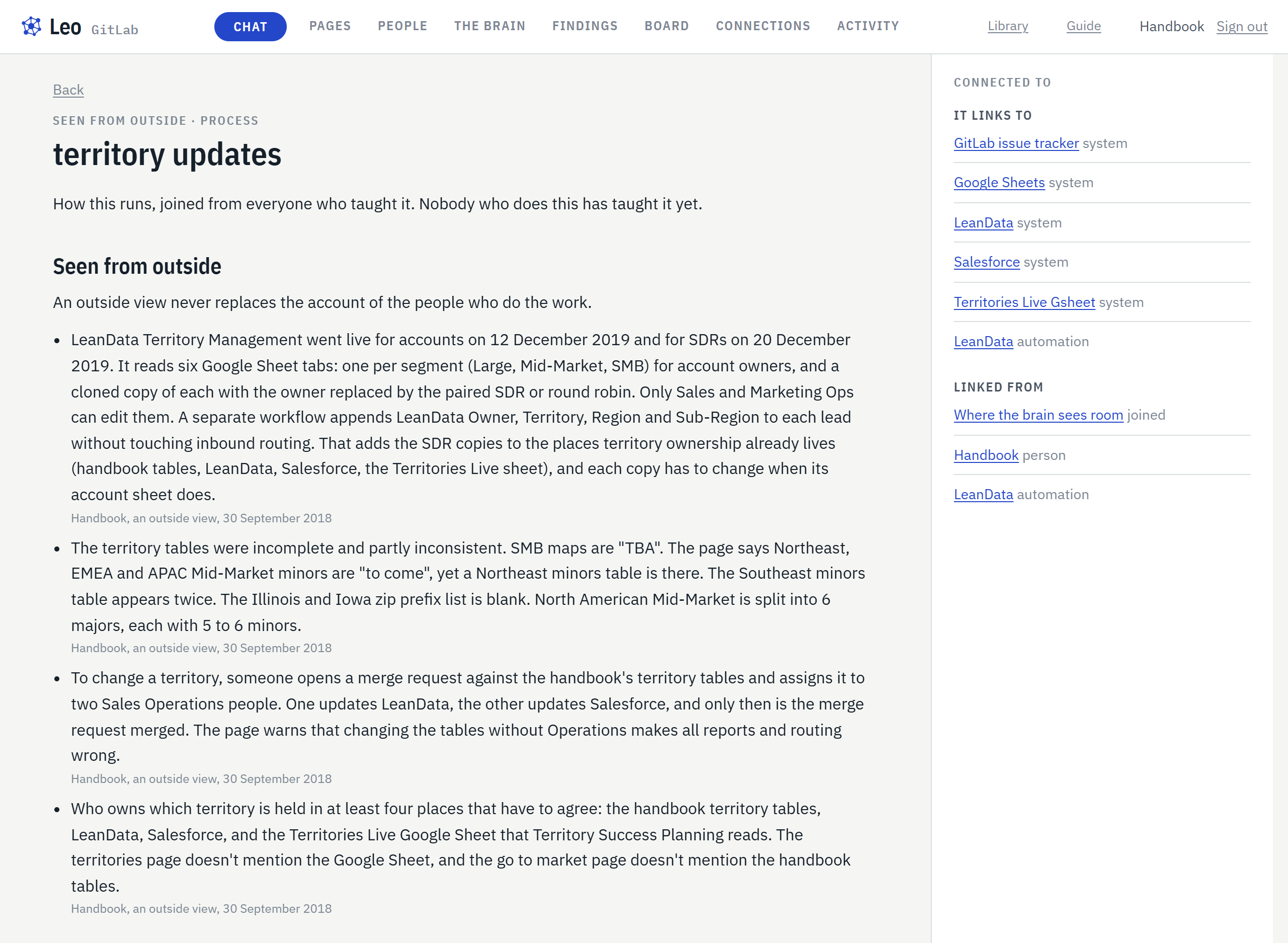
No single page told the whole story. The territories page did not mention the Google Sheet; the go to market page did not mention the handbook tables. Leo read them together: "Who owns which territory is held in at least four places that have to agree."
The ways forward
- Improve: one source feeds the rest. One of the four becomes the record, and the others read from it instead of being edited by hand.
- Eliminate: the copy tabs go. The three SDR copies of the sheets exist only to swap each owner for their paired rep. Hold the pairing once and let the routing tool work out the rep, and the copies, and the job of keeping them in step, disappear.
What happened next
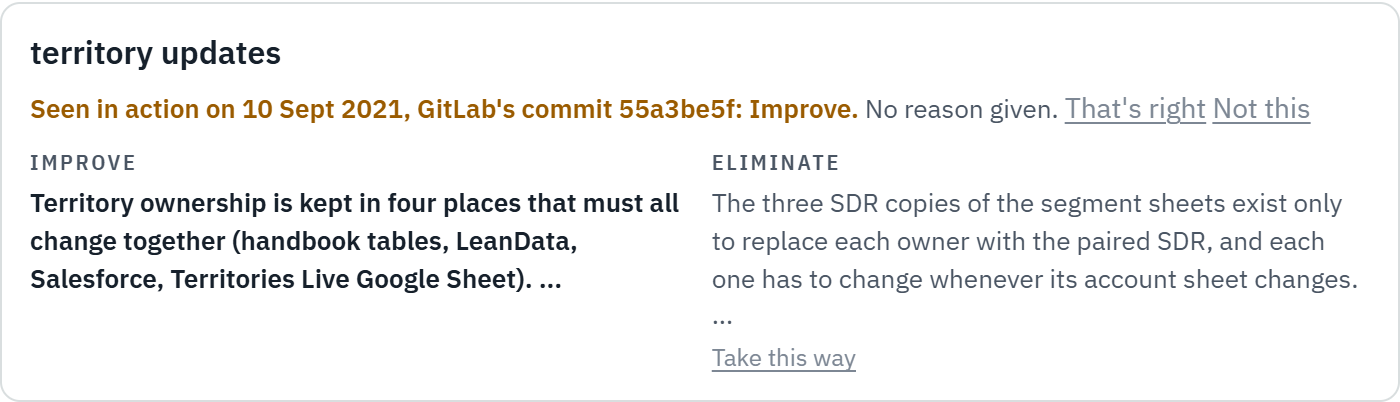
- 2021. The tables stayed, and so did the hand edits. Between January and early September the territories page was changed 86 times, most of them a single move: "Update territory owner: MM-AMER-FO-West and SMB-AMER-WEST-SF/LA", "Territories UK/I-5,6,7,8 & 10 merged...".
- 10 September 2021. "Update Territories page to link to internal doc." The handbook stopped being one of the copies: the page became a single link.
- 2022 and 2023. The routing pages still described ownership fields that, in the handbook's own words, are "not maintained by an automated workflow and therefore relies on manual updates."
So one of the four copies went, which is a step on the first way. The record does not show the rest fed from one source.
What this does not show
The internal document the page now links to is private, so we cannot see what it holds or how it is kept. Moving the tables out of a public handbook may have had reasons of its own. What is public is a year of one-at-a-time edits to keep four places in step, and the moment one of them was retired.
Leo learns how a business really runs by reading what its people write and talking with them, lays out the ways the work could go, and keeps the choice with the people who make it. When they take a path, its card records it, including one Leo did not offer.