What Leo saw at GitLab, 3. A promotion copied into five places, and the path nobody offered
In 2019 an approved promotion at GitLab was retyped into five places from the HR system. Leo offered two ways to stop the copying. GitLab chose a third in 2022: it replaced the HR system. Leo's card records the path it did not offer.
The first two stories in this series were about work Leo saw clearly. This one is about a path Leo did not see, and why that matters just as much.
GitLab had no part in this
We used GitLab's handbook because it is public and openly licensed (CC BY-SA 4.0). GitLab did not take part, and nothing here is GitLab's view of Leo. Every quote below links back to GitLab's own pages and commits.
The claims, and where to check them
| Claim | Source |
|---|---|
| Once a promotion was approved, it was copied by hand into payroll change docs, the compensation calculator spreadsheet, a sales pay doc, a signed letter and a tracker, from data the HR system already held | GitLab handbook, promotions and transfers page, 31 Dec 2019 (page at that commit) |
| In 2022 GitLab moved its people records to Workday, and replaced the sales pay sheet with a Workday report | Commit 72878ac8 (26 Jul 2022), commit 1bc8e14d (23 Aug 2022) |
| By 2023 most promotions ran through quarterly calibrations | Promotions page, 31 Dec 2022 (page at that commit) |
The work as it was
At GitLab in 2019, a promotion was approved in BambooHR, the HR system. Then the copying began. The handbook's checklist for the People Ops analyst: notify payroll in one of two Google Docs ("United States: 'Payroll Changes', Everyone else: 'Monthly payroll changes for non-US international team members'"), "Update the compensation calculator backend spreadsheet", and for anyone in sales, "update the changes tab on the 'Final Sales OTE FY 2020' google doc." Then stage the letter of adjustment in HelloSign, file the signed letter back in BambooHR, and log the move in a tracker.
Every one of those copies was of something BambooHR already held.
What Leo saw
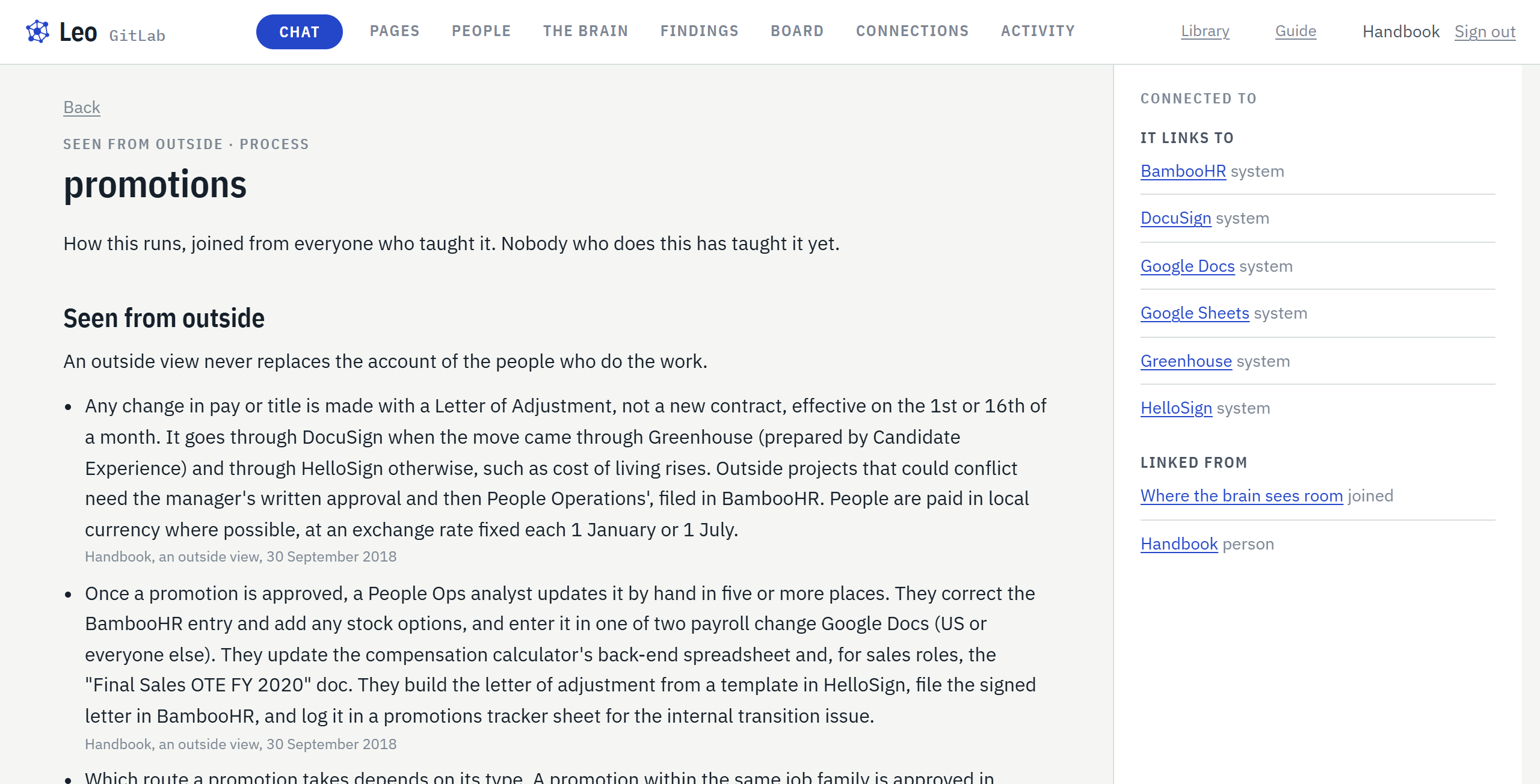
"Once a promotion is approved, a People Ops analyst updates it by hand in five or more places." Leo also noticed something the promotions page did not say: elsewhere in the handbook, GitLab already ran a read only bot on BambooHR, and had a data warehouse.
The ways forward
- Improve: feed the copies from BambooHR. Payroll docs, the calculator, the sales pay doc and the metrics read from the HR record instead of being retyped.
- Redesign: the letter writes itself. The letter of adjustment is generated from the approved request and sent for signature from there.
What happened next
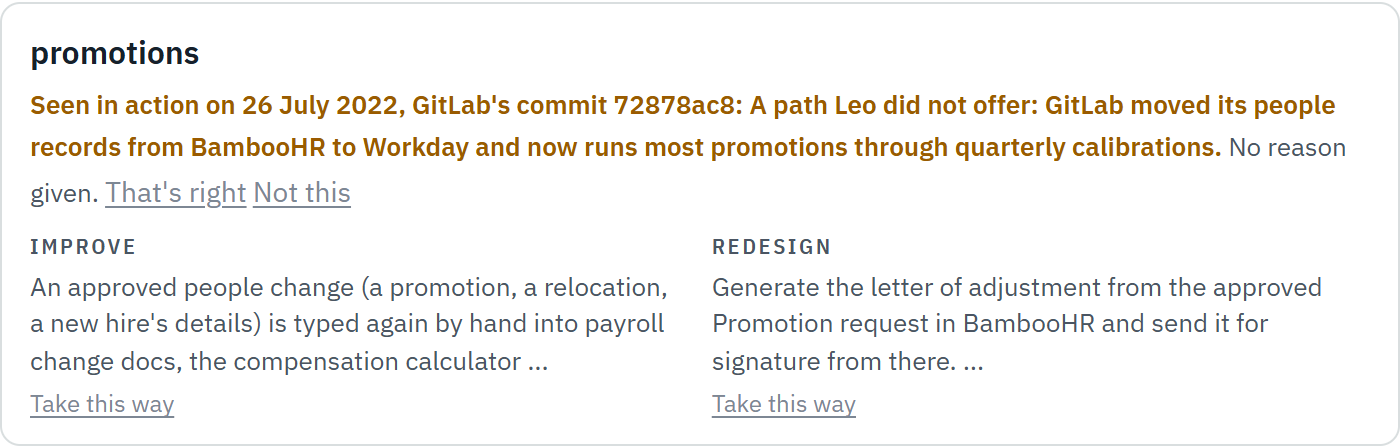
GitLab took neither. It took a bigger path.
- 2021 and 2022. The hand steps stayed, with new owners: the letter of adjustment, the BambooHR title updated by hand, the tracker.
- July 2022. The promotions page was rewritten "for accuracy with our new processes and Workday". GitLab had replaced BambooHR altogether.
- August 2022. The sales pay spreadsheet was replaced "with Workday report".
- 2023. Most promotions now ran through quarterly calibrations, processed in Workday by the people teams after the division leader approves.
Leo offered to make the old system feed the copies. GitLab changed the system, and the rhythm of promotions with it. On Leo's card that is recorded honestly: a path Leo did not offer, seen in the record, and the reason left blank, because the handbook does not give one.
Why that is the point
A tool that scores itself would call this a miss. Leo does not score itself. The people who run a business see things no document holds: that the HR system was about to be outgrown, that a public company needs a calibration cycle. Leo's job is to put the work and the options on the table, and to learn from the path people actually take. The next time Leo sees a business copying from a system it is about to outgrow, the card that recorded GitLab's choice is part of what it knows.
What this does not show
The handbook shows the move to Workday, not why GitLab made it or whether the copying stopped. Some hand steps, such as the letter of adjustment, still appear in 2023.
Leo learns how a business really runs by reading what its people write and talking with them, lays out the ways the work could go, and keeps the choice with the people who make it. When they take a path, its card records it, including one Leo did not offer.