What Leo saw at GitLab, 5. The investor update built by hand from 14 sources
Every month in 2019 GitLab's investor update was built by hand from 14 sources, and it went out before the books closed. Leo found the clash by reading two pages side by side. Two years later the monthly update was gone: GitLab reported quarterly as a public company.
We gave Leo GitLab's public handbook exactly as it stood on 31 December 2019, and nothing later. This one is about the report a company owes the people who back it.
GitLab had no part in this
We used GitLab's handbook because it is public and openly licensed (CC BY-SA 4.0). GitLab did not take part, and nothing here is GitLab's view of Leo. Every quote below links back to GitLab's own pages and commits.
The claims, and where to check them
| Claim | Source |
|---|---|
| Each month the investor update's metrics were copied by hand from 14 sources, then pasted into a static sheet and reformatted | GitLab handbook, FP&A page, 31 Dec 2019 (page at that commit) |
| The update was due by the 10th, while the books aimed to close within 10 business days, usually later | The same page and the accounting page |
| At the start of 2021 the update went out on business day 10 and the books closed on day 11 | FP&A page, 31 Dec 2020 |
| By 2023 the page described quarterly earnings as a public company | FP&A page, 31 Dec 2022 (page at that commit) |
The work as it was
"Each month we send to our investors an update no later than the 10th day following the end of the month." GitLab even blogged about how it keeps investors in the loop. The handbook set out how: on the 1st, a draft in a Google Doc and a call in Slack for each executive's part; by the 9th, the parts in; by the 10th, the CEO sends it.
Behind it sat the numbers. The handbook listed where each metric came from: a sales metrics sheet, Periscope for revenue and retention, four Salesforce reports, the controller's revenue spreadsheet, the cash flow forecast, uptime from Pingdom, headcount from BambooHR, Zendesk, Snowflake. Fourteen sources in all, each copied by hand into the revenue and financial models. Then the whole metrics tab was pasted into a static sheet, the forecast taken out, the cell colours changed and the links pasted back by hand.
What Leo saw
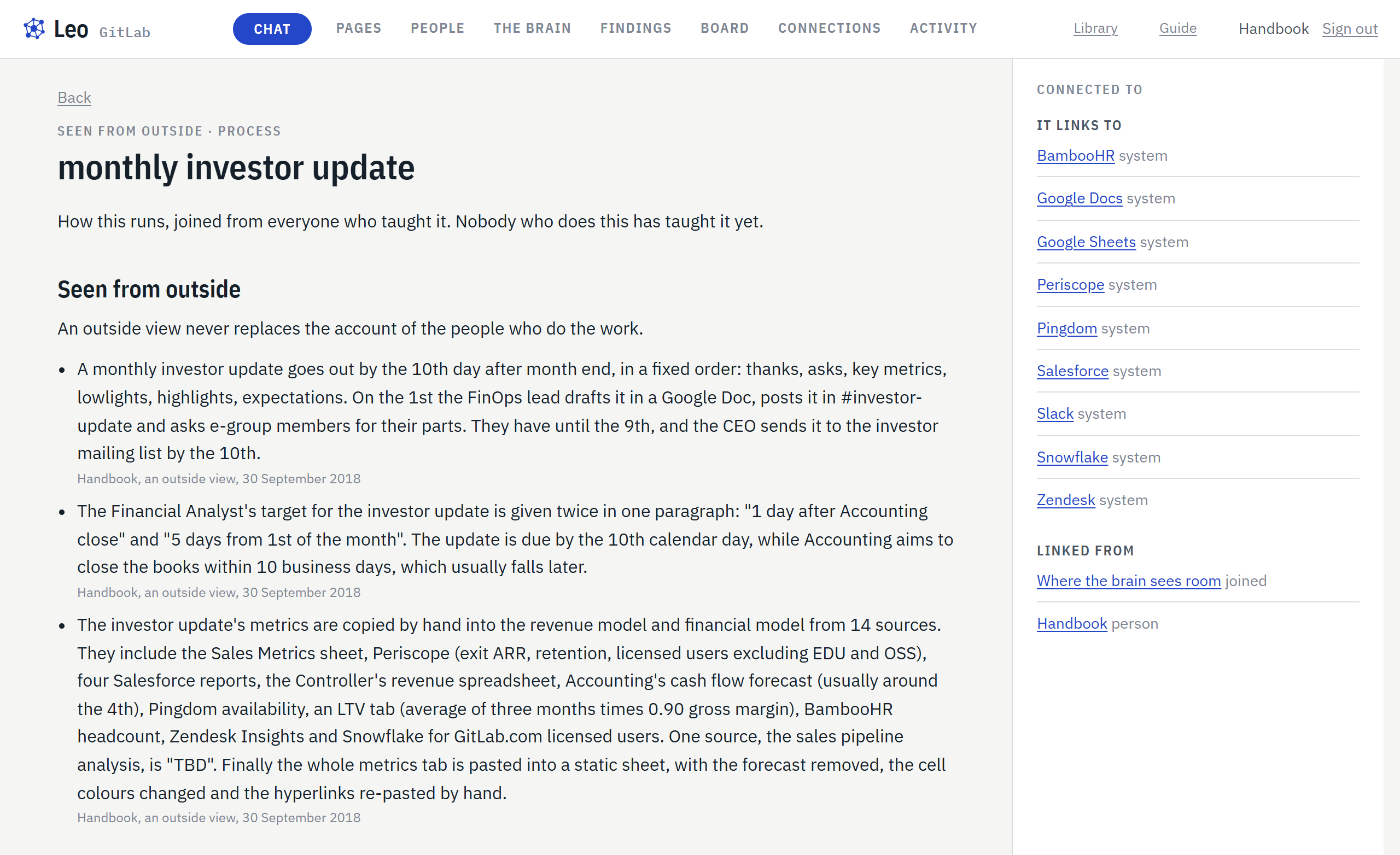
Two things, from two pages. First, most of those 14 sources already fed GitLab's data warehouse. Second, a clash in the calendar: the update was due by the 10th calendar day, while Accounting aimed to close the books within 10 business days, which usually falls later. The investor numbers were going out before the books they rested on were closed.
The ways forward
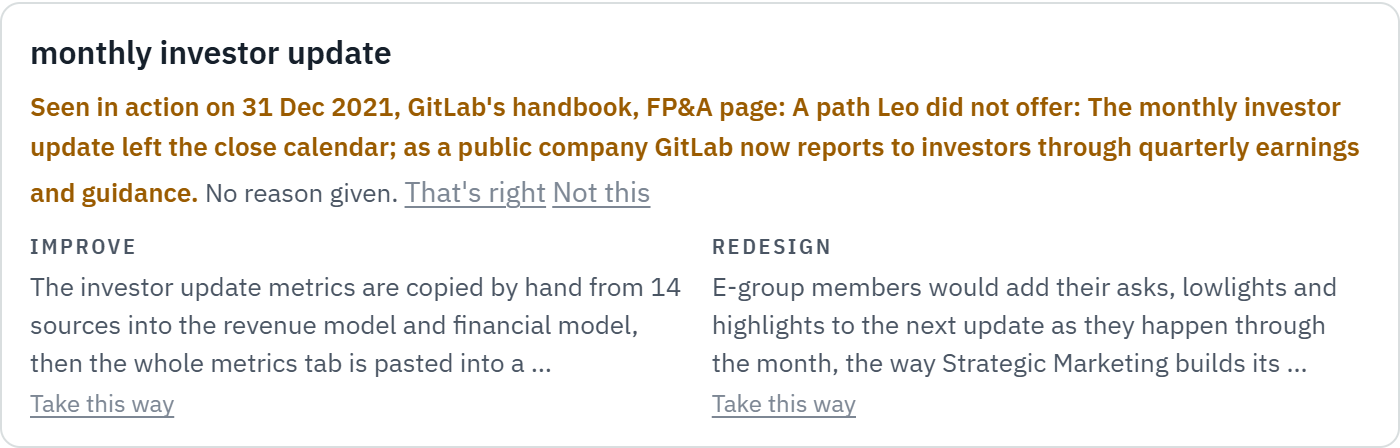
- Improve: fill the metrics from the warehouse. The snapshot builds itself, and people write only the commentary.
- Redesign: a running draft. Executives add their asks, highlights and lowlights as they happen through the month, the way GitLab's own marketing team built a recurring deck, so the update no longer starts from nothing on the 1st.
What happened next
- 2021. The update was still on the close calendar, and still went out first: "BD10: Investor update sent out by CEO. BD11: Updates to preliminary financials finalized, accounting closed."
- 2022. The monthly update no longer appears on the close calendar.
- 2023. The page describes something else entirely: "Drive quarterly earnings process as public company, including guidance and investor narratives."
The monthly update was not automated or turned into a running draft. The work it did changed shape when GitLab became a public company and began reporting quarterly. That is a path no reading of a 2019 handbook would offer, and Leo's card records it as one.
What this does not show
The handbook does not show whether the 14 sources were ever wired to the warehouse for other reports, or how the quarterly process is built. It shows a careful monthly routine, a calendar clash Leo found by reading two pages side by side, and a company whose reporting outgrew the routine.
Leo learns how a business really runs by reading what its people write and talking with them, lays out the ways the work could go, and keeps the choice with the people who make it. When they take a path, its card records it, including one Leo did not offer.