
An online toy store run by Leo, with the owner in for 45 minutes a week
A worked example. An invented online toy store hands its buying, listings, ads, articles, newsletter and customer emails to Leo under standing gos in the owner's own words. Through Black Friday and Christmas the hours the owner herself works in the business fall from about 45 a week to 6.2, and contribution rises 50.8%.
In three months, the owner of Hatherley Toy Co cut her own working week in the business from about 45 hours to 6.2, contribution rose 50.8% on the same months last year, and four changes are worth about $84,900 a year. She now makes the calls only she can make at a 45 minute chief of staff session with Leo every Monday. One part time packer ships the orders.
This business is invented
Hatherley Toy Co, its people, its suppliers, its customers and every figure are made up, to show what an AI native store looks like from start to finish. It runs in a real Leo, so every screen is the real product, connected to the same kinds of systems a real online store uses. The arithmetic is shown so you can check each number yourself.
Open it yourself: toys.smartleo.ai. It opens on the results. Press Watch how to see all eleven sessions, from the first conversation to the read three months on, with a caption at each step saying what just happened.
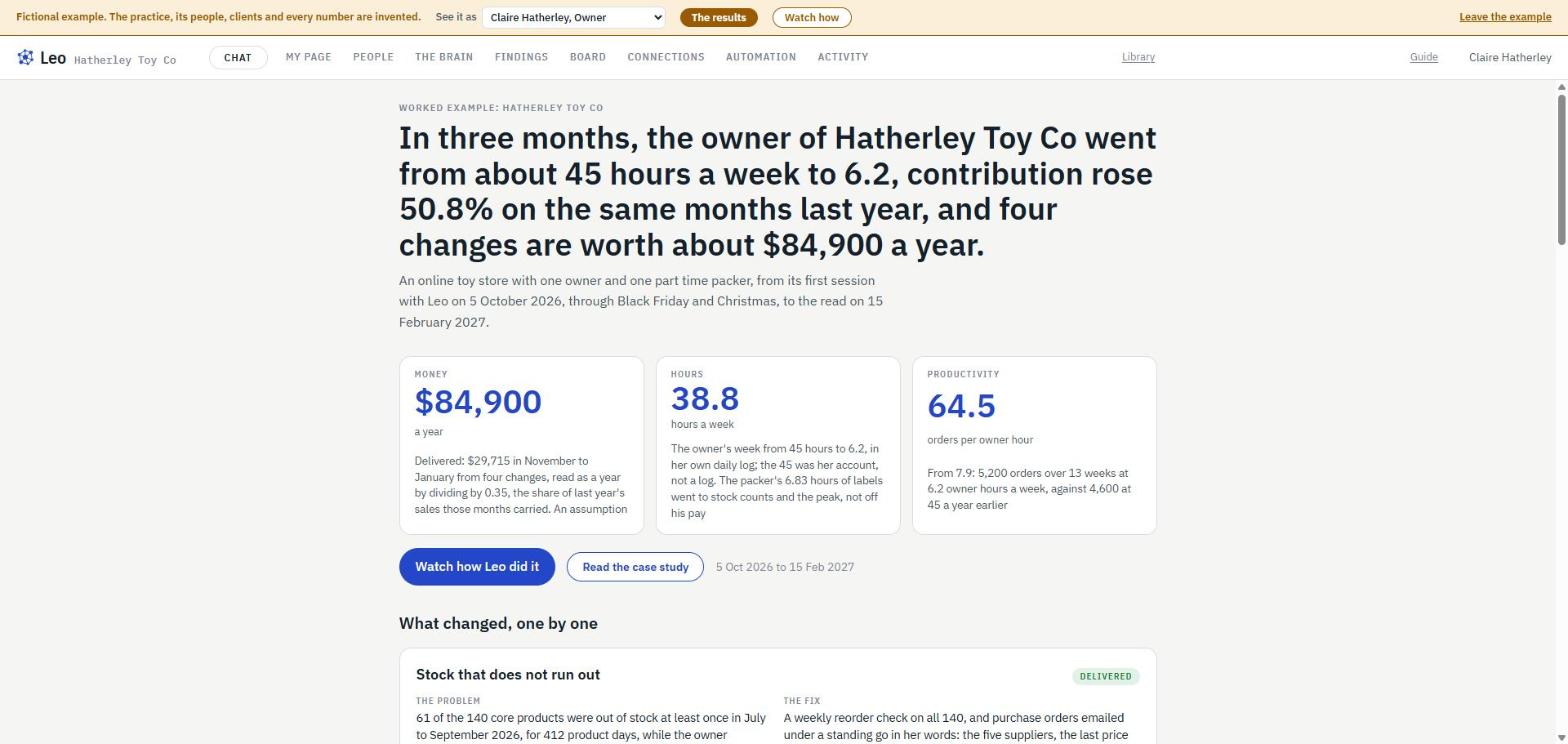
The result
| Delivered | What it means | |
|---|---|---|
| Money | $84,900 a year | $29,715 measured over November to January from four changes, read as a year. An assumption, shown below |
| Hours | 38.8 hours a week | Back in the owner's own week: she now works about 6.2 hours a week in the business, down from about 45, in her own daily log |
| Productivity | 64.5 orders per owner hour | From 7.9: 5,200 orders in 13 weeks at 6.2 owner hours a week |
The business
An online toy store, started at a market stall and online only since 2020: wooden toys, games and puzzles, craft kits, outdoor play, baby and toddler. About 900 products and $1.1 million a year in sales. The owner decides what it sells and where the money goes. One part time packer ships the orders from a unit on an industrial estate. An outside bookkeeper does the quarterly BAS.
Her brief, in her words: an AI native store that runs from buying the stock to selling it, ads, articles and the newsletter included, with someone packing and shipping, so that she makes the strategic calls at a weekly chief of staff session.
The systems it runs on
Shopify for the store, orders, stock and customers. ShipStation for labels and carriers. Omnisend for the newsletter. Judge.me for reviews. Meta ads through Porter, Google Ads and Google Merchant Center for Shopping. Google Analytics and Search Console. OpenSEO for keywords. fal for product and ad images. Notion for the decision journal. Gmail and Google Calendar for suppliers, customers and the weekly session. GitHub for the store's own scripts, which Leo runs.
The owner connected each one inside a session, as it came up. The packer connected ShipStation himself.
What "runs itself" means: standing gos
Leo never acts alone. Everything it does without asking sits inside a standing go: the owner, or the packer for his own work, says in their own words what Leo may do and where the limit is. Inside a go, Leo acts and reports at Monday's session. Outside it, Leo stops and brings the choice to her.
| Standing go | In her words | The limit |
|---|---|---|
| Reorders | "Reorder anything on the core list when it drops under four weeks of cover, from the five suppliers, at the price we last paid." | $4,000 an order, $12,000 a week |
| Ads | "Meta up to $300 a day, Google up to $180. Pause anything under two to one once it's spent $300." | The daily caps, and the pause rule |
| Shopping feed | "Keep it clean. Any fix that doesn't change a price." | No price changes |
| Newsletter | "See it Mondays, in our session. It goes Thursday at seven." | No discount over 10% without her |
| Articles | "One a fortnight from that list, and tell me what went up." | One a fortnight |
| Reviews | "Reply to all of them, but the one and two stars, draft it and wait for me." | One and two stars held |
| New listings | "When I've picked a range, list it." | Five suppliers, RRP, never under 45% margin |
| Customer emails | "Where's my order, always. Returns inside thirty days, and refunds up to eighty dollars." | Refunds over $80 come to her |
| Morning labels (the packer's own) | "Every morning, have them ready by half eight. Cheapest one that gets there on time." | He checks them before he prints |
The gos move with the business, and the example shows all three ways. In November Leo held a $7,896 Christmas order to a supplier because it was over the $4,000 limit; the owner widened the go to $8,000 an order until 18 December. In January she widened returns for Christmas presents to the end of the month, and narrowed Meta to $180 a day for past buyers only while new customers were not paying back.
What changed, one by one
1. Stock that does not run out
The problem. 61 of the 140 core products were out of stock at least once in July to September, for 412 product days. The owner believed the store "hardly ever" ran out. She checked the top sellers by eye twice a week, and nobody watched the other 120.
The fix. A weekly reorder check on all 140, and purchase orders emailed to suppliers under the reorder go.
Before and after. Product days out of stock in November to January went from 466 to 97, 36 of them one supplier's late container. Sales lost to empty shelves went from $31,400 to $6,900. Her buying time went from 10 hours a week to 1.25.
The saving. 8.75 hours a week, $26,040 a year. Working: $24,500 more sold x 37.2 cents of contribution in each dollar = $9,114 in three months; / 0.35 = $26,040 a year.
2. Ads that pay or stop
The problem. About a fifth of Meta's spend went on ad sets returning less than two dollars for each dollar. She spent 6.5 hours a week watching the ads, and 63 products were kept out of Google Shopping by feed errors.
The fix. The ads go, with daily caps and a rule that pauses any ad set under two to one once it has spent $300. The feed kept clean by any fix that does not change a price.
Before and after. Spend on ad sets under two to one went from $14,800 to $2,600, each paused when it crossed the line. Sales for each ad dollar went from $5.95 to $7.76.
The saving. 7.4 hours a week, $34,857 a year. Working: $12,200 less wasted in three months; / 0.35 = $34,857 a year.
3. Labels ready before the packer arrives
The problem. The packer made every label by hand, about 8 hours a week, comparing carriers for each bulky parcel. In the week Leo first counted, 21 of 210 orders in by 1 pm missed the same day post.
The fix. Labels made each morning by 8:30 on the cheapest service that meets the promise, with a pick list by shelf. He checks and prints.
Before and after. Same day dispatch went from 88.8% to 98.1%. Shipping went from $6.20 an order to $5.40. The owner, who used to pack about 3 hours a week, no longer packs.
The saving. 9.83 hours a week, $11,886 a year. Working: $0.80 an order x 5,200 orders = $4,160 in three months; / 0.35 = $11,886 a year. The packer's 6.83 hours moved to stock counts and the peak. His pay was not cut.
4. Customer emails and reviews under a go
The problem. About 60 customer emails a week, most of them "where's my order", and 30 reviews took her 7 hours a week. A customer waited a median 9 hours for a first reply.
The fix. Where's my order, returns and refunds up to $80 answered under her go, in the store's own voice. Her test was whether it sounded like her.
Before and after. 977 of 1,046 emails answered under the go and 69 brought to her. 412 reviews replied and 9 held for her. The first reply now comes in a median 38 minutes.
The saving. 6.4 hours a week. No money is counted for this one.
5. Newsletter, articles and listings
The problem. The weekly newsletter took 4 hours and was often late. The blog got an article "once a month, if that". Listing new products took 6 hours a week.
The fix. The newsletter drafted for Monday's session and sent on Thursday. One article a fortnight from keyword research. New ranges she picks listed with images, never under 45% margin.
Before and after. Email revenue went from $29,800 to $41,200 for November to January. Eight articles were published on time and 86 products listed. Search revenue went from $2,700 to $3,100.
The saving. 11 hours a week, $12,117 a year. Partly delivered: the articles are on time but are not paying yet, so their $400 is not counted.
6. The bookkeeper's quarter
Not yet delivered. Getting payouts, receipts and bills to the outside bookkeeper takes the owner about 2 hours a week. Leo can send Shopify's finance report each month in the form she asks for, but the bookkeeper has never answered. Nothing is counted.
A week, now
On Monday at 8:00 the owner opens Leo. The chief of staff pack is waiting: what Leo did under each go last week, the numbers against the goal, and the two or three calls only she can make, such as a supplier's price rise, an offer for Black Friday, or a product below the margin floor. She decides them in 45 minutes. The rest of the week, Leo runs the work and the packer ships.
What this example does not prove
- The figures are invented. The example shows how a store runs with Leo and how the savings are measured. It is not evidence that any real store will get these numbers.
- The money is three months read as a year. $29,715 was measured over November to January and divided by 0.35, the share of last year's sales those months carried. Peak months may not repeat their gains through the rest of the year.
- The 45 hours is the owner's own account. Her log only started in late October. The 6.2 is from the log.
- $10,710 of the rise in contribution is not claimed. Contribution rose $40,425 on the same months last year; the cards account for the rest, and the remainder may be the market or the season.
- The articles have not paid yet. Search is slow; the example stops before it can tell.
- One gap is a person, not a system. The bookkeeper never answered, and Leo cannot change that.
What Leo did, and what the people did
Leo read the store's systems, watched the stock, ads, feed, inbox and reviews, drafted the purchase orders, newsletters, articles, listings and replies, and acted only inside the gos the owner and the packer gave it, in their words. The owner decided what the store sells, every price, every offer and every limit. The packer packs and ships, and his job and hours were off limits from the first session.