
An accounting practice gets 9.2 hours a week back in three months
A worked example. An invented eleven person accounting practice teaches Leo how it runs, makes four of the changes Leo finds, and three months later has 9.2 hours a week back, about $108,000 a year, and returns signed in 5 working days instead of 9.
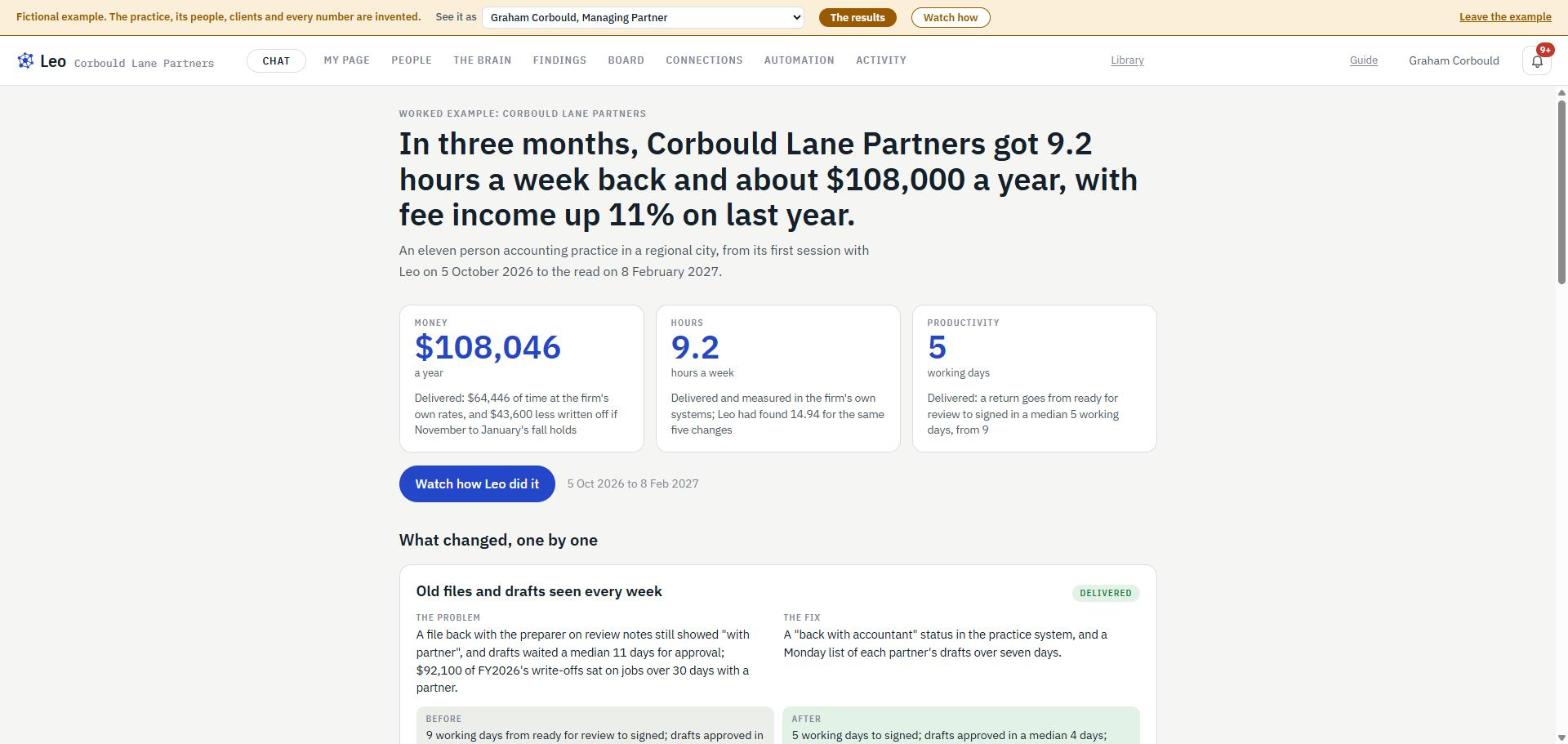
In three months, Corbould Lane Partners got 9.2 hours a week back and about $108,000 a year, with fee income up 11% on last year. Every figure below comes with its working, and you can open the practice's Leo and watch where each change was found.
This business is invented
Corbould Lane Partners, its people, its clients and every figure are made up, to show what Leo does from start to finish. It runs in a real Leo, so every screen is the real product. The arithmetic is shown so you can check each number yourself.
Open it yourself: example.smartleo.ai. It opens on the results. Press Watch how to see all nine sessions, with a caption at each step saying what just happened.
The result
| Delivered | What it means | |
|---|---|---|
| Money | $108,046 a year | $64,446 of time at the firm's own rates, and $43,600 less written off if November to January's fall holds |
| Hours | 9.2 hours a week | Measured in the firm's own systems. Leo had estimated 14.94 for the same five changes |
| Productivity | 5 working days | From ready for review to signed, down from 9 |
The business
An eleven person practice in a regional city: two partners, a practice manager, accountants, a bookkeeping team and a front desk. The managing partner wanted fee income of $2.4 million for the year, up $260,000, with the same eleven people.
Over five weeks, five of them each spent a session telling Leo how their part of the work runs. They connected their mail and calendars, the practice system, the CRM and the document store as they went. Leo put what each person said beside what the systems showed, and where the two did not match, it asked.
What changed, one by one
1. Old files and drafts seen every week
The problem. A file sent back to the preparer with review notes still showed "with partner", so nobody could see where it really was. Draft invoices waited a median 11 days for a partner's approval. $92,100 of the year's write-offs sat on jobs that had been with a partner for more than 30 days.
The fix. A "back with accountant" status in the practice system, and a Monday list of each partner's drafts over seven days.
Before and after. Ready for review to signed went from 9 working days to 5. Drafts are approved in a median 4 days, from 11. Write-offs on jobs over 30 days with a partner fell from $24,100 to $13,200 for November to January.
The saving. 2.2 hours a week and $53,214 a year. Working: the practice manager's chasing fell from 90 to 18 minutes a week and her lodgment spreadsheet from 90 to 30 minutes, 2.2 hours; 2.2 x 46 weeks x $95 = $9,614. Write-offs fell by $10,900 in three months; x 4 = $43,600 a year if it holds. $9,614 + $43,600 = $53,214.
How Leo found it. The managing partner said the write-offs were about $40,000. The report he signs every month said nearly four times that. He reads the line that is his own.
2. Simple returns signed by the senior accountant
The problem. The managing partner reviewed all 32 individual returns a week himself, though about 19 had no rental, no capital gains and no business income.
The fix. From 1 December the senior tax accountant signs off simple returns, and the partner checks one in five.
Before and after. His review pile went from 31 files to 7. Seventeen simple returns a week are now signed by the senior accountant.
The saving. 1.13 hours a week saved outright, and 3.4 partner hours a week moved to client work, worth $29,180 a year. Working: the partner saves 17 x 15 = 255 minutes, less 51 for sampling, so 3.40 hours a week at $250 = $39,100 a year. The senior accountant spends 2.27 hours at $95 = $9,920. $39,100 - $9,920 = $29,180.
How Leo found it. Leo could see the time this took. It said plainly that who signs a return is a choice about authority and risk, and it belonged to the managing partner, not to Leo. He decided on 6 November.
3. Three review notes on the checklist
The problem. 104 of the 169 returns sent back in July to September were sent back for the same three notes, which the preparers' checklist did not carry.
The fix. The three notes were added to the checklist on 29 October.
Before and after. Returns sent back for those notes went from 8 a week to about 1.5. Returns sent back with notes went from 40.6% of those reviewed to 21.3%.
The saving. 3.77 hours a week, $16,475 a year. Working: 6.46 fewer returns a week x 35 minutes each = 3.77 hours; x 46 x $95 = $16,475. Leo had estimated 4.67; most of the returns still sent back are clients with no depreciation schedule at all, which a checklist cannot fix.
How Leo found it. Leo asked the senior tax accountant for the review notes tally over a named quarter, instead of asking her to explain the system, and counted which notes came up most.
4. Returns signed in DocuSign
The problem. Every return was posted out for a signature: 12 minutes each at the front desk and a median 8 days to come back. The firm already paid for DocuSign, bought for engagement letters.
The fix. From 1 December every client is offered DocuSign. Paper stays for those who ask for it.
Before and after. 14 of the 22 returns a week now go by DocuSign and come back in a median 1 day. 8 older clients kept the envelope.
The saving. 2.1 hours a week, $9,177 a year. Partly delivered. Working: 22 x 12 = 264 minutes before; 8 x 12 + 14 x 3 = 138 minutes now; 126 minutes saved, 2.1 hours; x 46 x $95 = $9,177. Leo had estimated 4.2 with every return on screen.
How Leo found it. Describing the paper round, the practice manager mentioned in passing that the firm uses DocuSign for engagement letters. Nobody had thought to use it for returns.
5. Records reminders from the practice system
The problem. Chasing clients for missing records by phone took about 8.25 hours a week.
Not yet delivered. Nobody has agreed who keeps the one list of missing items, so the reminders have not started. Leo estimated 3.3 hours a week if 40% fewer calls are needed. Nothing is counted until it is measured.
What this example does not prove
- The figures are invented. The example shows how Leo works and how the savings are measured. It is not evidence that any real firm will get these numbers.
- $43,600 of the money is a projection. It assumes three months of lower write-offs hold for a year. If they do not, the money is $64,446.
- Partner time moved is worth money only if it is billed. $39,100 of the $108,046 is partner hours freed for client work at $250 an hour. It becomes fee income only if those hours are used that way.
- Three months is short. The fee income rise is partly timing: drafts waiting for approval fell from $96,400 to $41,800, so invoices went out sooner.
- Leo's estimates ran high. It found 14.94 hours a week for these five changes; 9.2 were delivered. The gap is shown change by change above, because that is what you would want to know before you trust the next estimate.
What Leo did, and what the people did
Leo listened, read the firm's own systems, put the accounts side by side, did the arithmetic out loud, and drafted the emails, invites and messages. Every one went out only after the person said go. The people decided every change. Leo never decided who signs a return or which clients keep paper.