Why Leo is built on game theory
A business is not one mind. It is people whose goals only partly overlap, and Leo is designed around what each of them has reason to do.
Most AI projects don't fail on the technology. They stall on people, and usually nobody decided to stall them.
Leo was designed around that from its first day. The thinking comes from game theory: the study of what people do when their goals only partly overlap.
A business is not one mind
Ask a business what it wants and the answer is "to make as much money as possible". It is never the real answer, and it is never one answer. More return means more risk, and everybody draws that line somewhere different.
The board wants AI. The chief executive wants a happy board and a happy team. The technology team guards its ground. Staff want to keep their jobs. Each of them would trade risk against reward differently, and most never say where they sit.
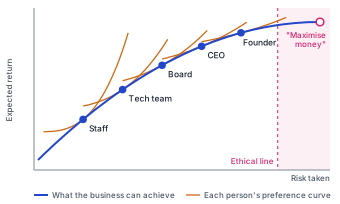
Choosing a point on that curve is a question of preference. Moving the whole curve outward is a question of capability. A business needs help with both, and most AI tools only see the second.
Holding back is rational
Picture being asked to teach the company's AI everything you do. If that looks like teaching it to replace you, staying quiet is the sensible move. So is the careful answer, and so is describing the documented process and leaving out the real one.
That is not a bad attitude. It is a rational response to the situation, and no amount of friendly interviewing fixes an incentive that is wrong.
So Leo doesn't try to talk people out of their own interests. Every part of it is tested against one question: what does this make rational for each person it touches? A design that only works when somebody acts against their own interest does not work.
What that changes in Leo
You are the authority, never the subject. The person who does the work is the authority on how it is done. Leo models how the work runs. It never scores a person, and nothing it produces ranks one person against another.
What you say about yourself stays with you. What you find hard, and what you think of the whole exercise, is yours alone. Here is exactly what Leo keeps private.
You get something back. If people hand knowledge upward and only the top gains, holding back is the smart play. So whoever teaches Leo gets credit by name for what they taught, and answers that draw on what the rest of the business knows.
Leo never quietly picks a winner. When two people describe the same handoff differently, Leo keeps both accounts, and the difference is the finding. Where goals pull apart, it shows the trade off and the person accountable makes the call, in their own name.
Authority from the top, truth from the bottom. A leader can start Leo. Nobody can order honesty. The four points above are what earn it.
Still being built
Leo keeps differing accounts side by side today. A view of its own that sets out who gains and who loses under each option is not built yet.
If you run the business alone
Most of this matters less. There is one set of goals, and it is yours.
What carries over is the habit. You still trade risk against reward every week, so Leo shows you the trade off, says what it rests on, and leaves the call with you.
Where it comes from
Leo's founder spent 25 years managing money, where every return is priced against its risk, and holds a PhD in behavioural finance, the study of how people really decide. Leo is that thinking applied to a business.