What Leo saw at Sourcegraph, 1. The reason for late invoices, written down and left alone
In 2021 Sourcegraph's handbook named why invoices ran late: 'missing contact or PO information'. Leo suggested carrying those details on the closed deal. When the handbook was archived in June 2024, the page was word for word the same.
Sourcegraph builds code search for software teams, and until 2024 it ran on a public handbook. We gave Leo the handbook exactly as it stood on 31 December 2021, and nothing later.
Sourcegraph had no part in this
We used Sourcegraph's handbook because it is public and openly licensed (Apache 2.0). Sourcegraph did not take part, and nothing here is Sourcegraph's view of Leo. Every quote below links back to Sourcegraph's own pages and commits.
The claims, and where to check them
| Claim | Where to check it |
|---|---|
| A signed customer contract was saved twice, keyed into Salesforce by hand, then used again by Finance to raise the invoice in Xero | Sourcegraph's handbook, sales and finance pages, 31 Dec 2021 (the accounts receivable page at that commit) |
| The handbook named the cause of late invoices: "invoicing delays occur primarily due to missing contact or PO information" | The same page |
| The page read word for word the same in June 2024, when the handbook was archived | Sourcegraph's accounts receivable page, June 2024 |
| Leo was taught the handbook's 609 pages for US$45 | Leo's own run log |
The work as it was
When a deal closed at Sourcegraph, the signed contract was saved in a Drive folder and again on the Salesforce opportunity. The opportunity was then completed by hand: products, stage, value, the win reason, start and end dates. Then Finance raised the invoice: "An account receivable balance arises when the Finance team issues an invoice via Xero after a deal is won in Salesforce."
And the handbook said, plainly, what went wrong: "The Finance team has identified invoicing delays occur primarily due to missing contact or PO information." The fix it offered was a checklist for sales: get the billing contact right, find out whether the customer needs a purchase order, secure it before invoicing.
What Leo saw
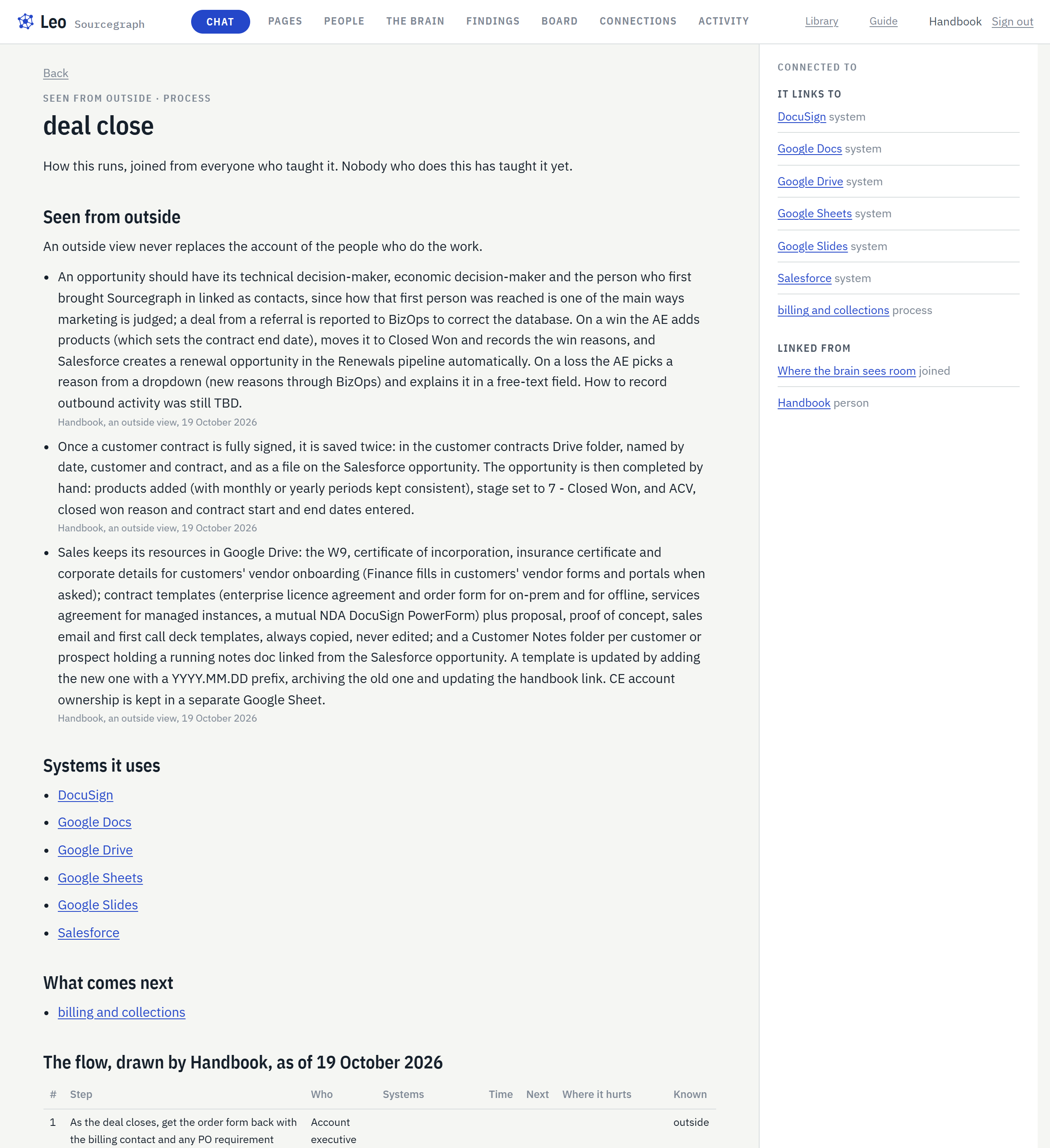
Leo joined the sales pages with Finance's, and saw one contract keyed in three times, and the details that would have prevented late invoices never travelling with the deal.
The ways forward
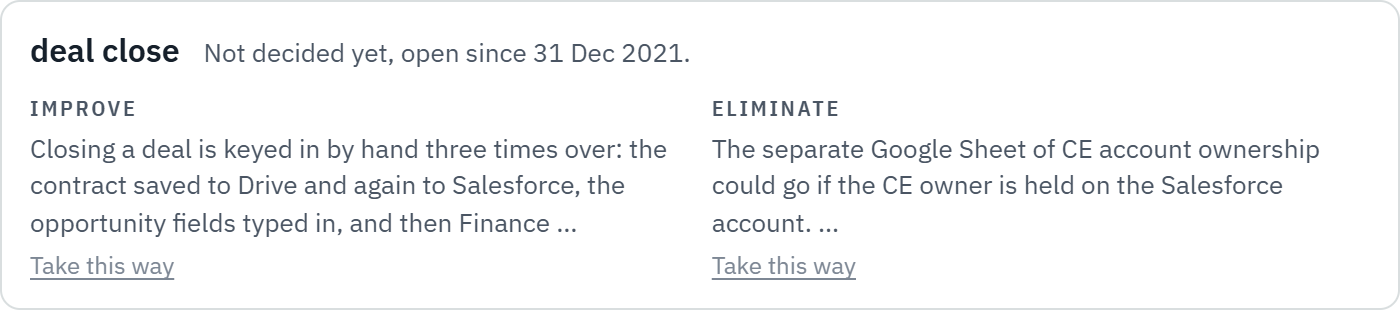
- Improve: the closed deal carries what Finance needs. The billing contact and the purchase order are fields on the won opportunity, and the draft invoice comes from it, instead of Finance retyping the contract and chasing what is missing.
- Eliminate: the separate ownership sheet goes. The customer engineer who owns each account is held on the Salesforce account, as other processes already assume, and the side spreadsheet is retired.
What happened next
- 2023. The accounts receivable page was unchanged. The same cause, the same checklist.
- 2024. Still word for word the same.
- June 2024. The handbook was archived with the page as it was in 2021.
The cause was diagnosed, written down and handed to sales as a checklist, and the work around it stayed the same for two and a half years. Leo's card stays not decided yet. A checklist is a choice, and a fair one: building billing details into the deal record means changing a sales system, and that has its own cost.
What this does not show
The handbook shows the process, not how often invoices were actually late, or whether a tool outside the handbook helped. What it shows is a problem named by the people who lived with it, and left as it was.
Leo learns how a business really runs by reading what its people write and talking with them, lays out the ways the work could go, side by side, and keeps the choice with the people who make it. When they take a path, its card records it, including one Leo did not offer.